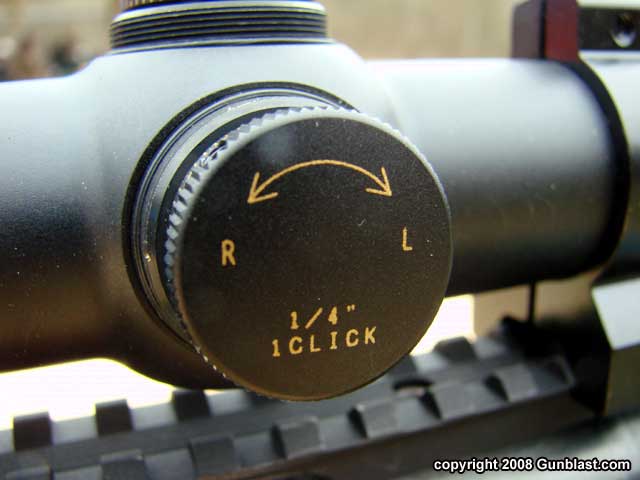
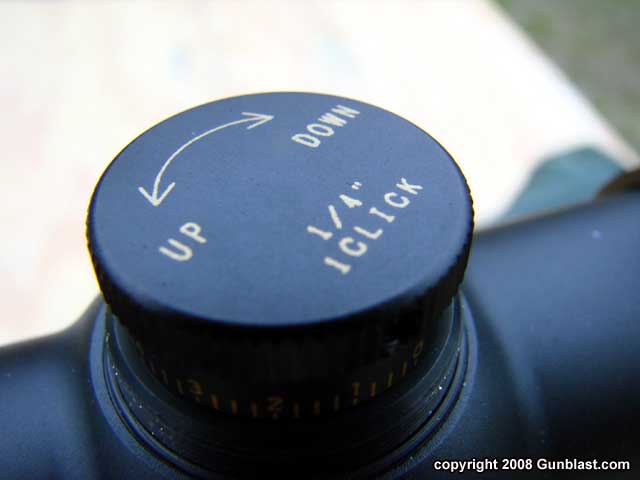
|
UPDATE!
July 14th, 2008
Pride-Fowler is now offering a 10% discount
to Gunblast.com readers! Just call in your order and mention
that you read the review on Gunblast.com to receive your
discount.

As an adolescent and budding
firearms aficionado in the late 1970’s and early 80’s, I
followed the beginning of the then new shooting sports of IPSC
and “action shooting” for handguns.
Back then, Bianchi Gunleather started their own
action shooting match called the Bianchi Cup. With the
advent of these new disciplines, new champions began to emerge.
Two of the early champions of the Bianchi Cup competition
were John Pride and Mickey Fowler.
Fast forward about thirty years.
John Pride and Mickey Fowler have pretty much hung up
their handguns, but still remain active in the shooting sports.
So much so, that they got together and designed a rifle
scope featuring a unique bullet drop compensating reticle.
They formed a business – Pride-Fowler, INC. –
and began making scopes.
I stumbled across Pride-Fowler
scopes a few years ago in an article in Precision
Shooting magazine. The
article I read explored the Pride-Fowler scope’s utility as a
“tactical” scope, but noted that its features would
translate well to other disciplines. Since
I work for a state wildlife agency, it seemed logical that these
scopes could be useful for field biologists when
“collecting” deer for biological data.
A letter was forwarded to Pride-Fowler and soon, a
cardboard box arrived.
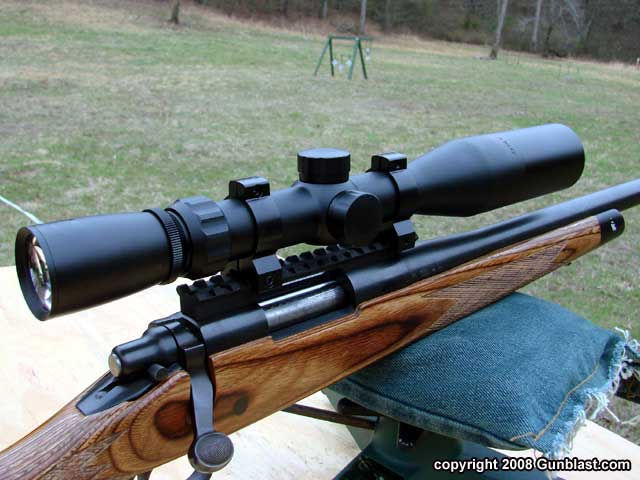
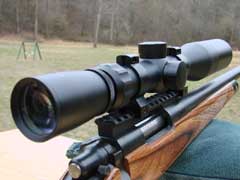
The scope that is the subject of
this article is the Model RR800-1.
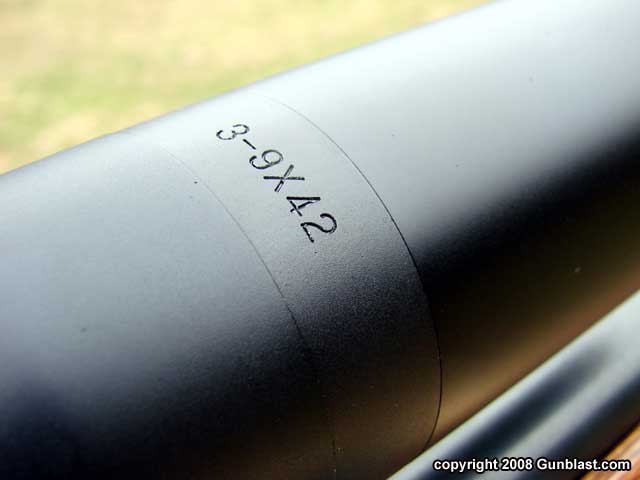
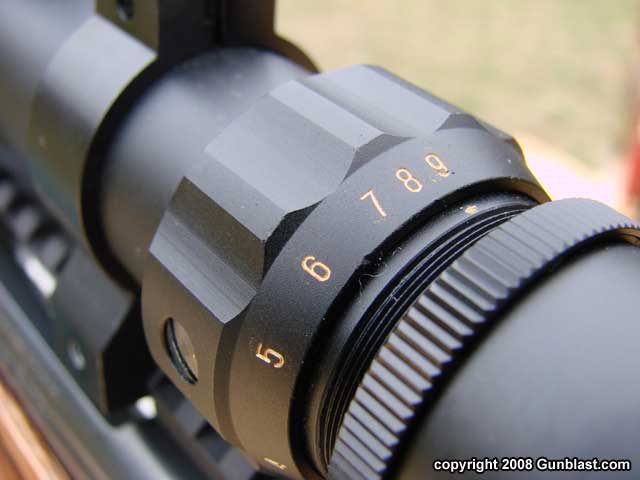
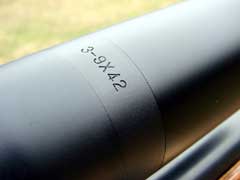
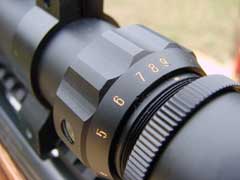
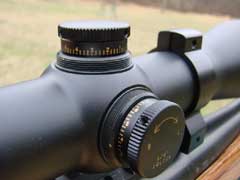
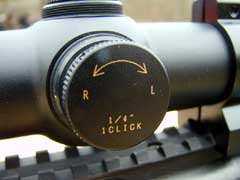
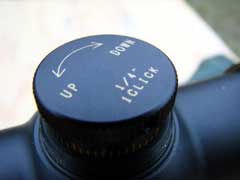
The RR800-1 is a 3-9 power
variable scope. It
has a 30mm main tube body and the objective bell is a nominal
42mm (or at least, it accommodates a 42mm lens).
It is a sturdy scope but not noticeably heavy or heavier
than any other scope of its type.
In other words, it doesn’t look like the Hubble Space
Telescope when mounted on a rifle as some “tactical” scopes
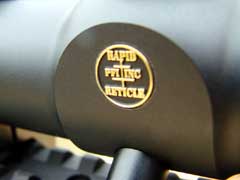
do. The Rapid
Reticle is located in the first focal plane of the scope. That
little tidbit of information may mean nothing to you as you read
this, but when you look through the scope, you will notice that
as the power is changed, the size of the reticle increases (with
and increase in power) or decreases.
So what? Well,
if you are using the reticle to range a target of a known size,
then the reticle can be used to range at any power, since the
values or subtensions of the reticle marks stay the same
relative to the target size at any power.
Huh? That’s
what I first said, but some discussion with Fermin Garza
got my mind right. More on that later.
When I received the scope, I had
just traded into an older Remington Model 700 VLS in .308
Winchester. One of
the cartridges the Rapid Reticle is designed around is the Federal
Gold Medal Match .308 round(s) using either the Sierra
Match King 168 grain BTHP or Sierra’s 175 Match King BTHP. There
are so many good Picatinny-style scope rails on the market right
now that finding one isn’t a problem – choosing one is.
I went with an Evolution Gun Works model which is
CNC milled from an aluminum alloy billet.
I still needed rings.
Luckily, while I was telling a friend about needing rings
he said he had a pair he would lend me.
So the scope was mounted on the Remington and off to the
range we went.
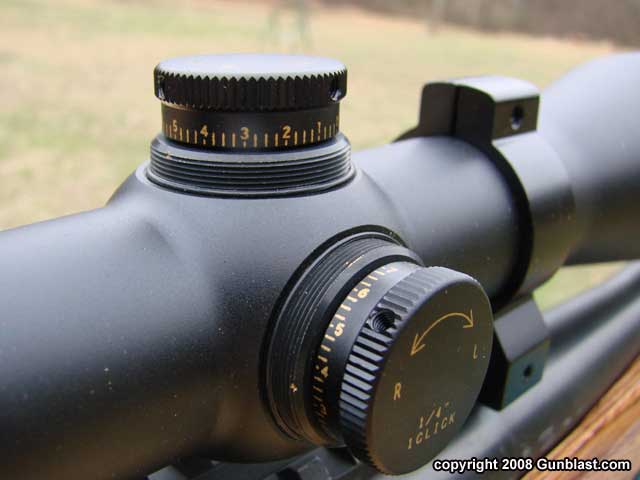
Boresighting and zeroing were
uneventful. If you
look at the reticle though, you’ll notice that the 100 yard
crosshair is in the top third of the sight picture.
This took some getting used to, but it certainly makes
sense when looking at holding over for longer ranges.
Once sighted-in at 100 yards, it was no problem to
repeatedly hit a steel silhouette at 150 yards by holding
between the 100 and 200 yard crosshairs.
Bad weather kept me from being
able to do any more known distance shooting; however, I did take
the rig to the annual CSA gathering in Clarksville,
Arkansas. Even
though the distances to the various steel targets were
approximations, I had no trouble hitting with the rifle and
Federal ammo using the marked crosshairs or holding between for
the between distances. Quite
simply, the Rapid Reticle works.
Unfortunately, I think that the
Rapid Reticle and the Pride-Fowler scopes really need to be
“lived-with” for about a year or so to really begin to
realize their potential. I
mentioned ranging earlier in this review.
To really make the most out of this scope, I need to take
it to some known distance ranges and check the subtensions of
the reticle against items of known size.
For instance, an average white-tailed deer is about 18
inches from belly to shoulder.
A target that is 18 inches square needs to be put at 100
yards and checked to see which crosshairs it fits between, then
that information needs to be recorded on a range card that will
stay with that rifle. The exercise should be repeated at 200,
300 and so on until range data is compiled for known size
targets. Since the
reticle is in the first focal plane, that information will stay
the same at any power…, and that is the advantage of FFP
scopes. (It is also
possible to determine how many mils the reticle subtends and use
milling and/or MOA formulae to calculate ranges, but the
simplest way to use it is as I described).
In a hunting scenario, you glass the deer, see which
and/or how many crosshairs it takes to bracket him, check your
range card, then hold on at the appropriate yardage crosshair
and shoot. For a hunter who has opportunities to take shots out
to 400 yards or more, it makes sense, especially if he has paid
big dollars for an elk or some other guided hunt.
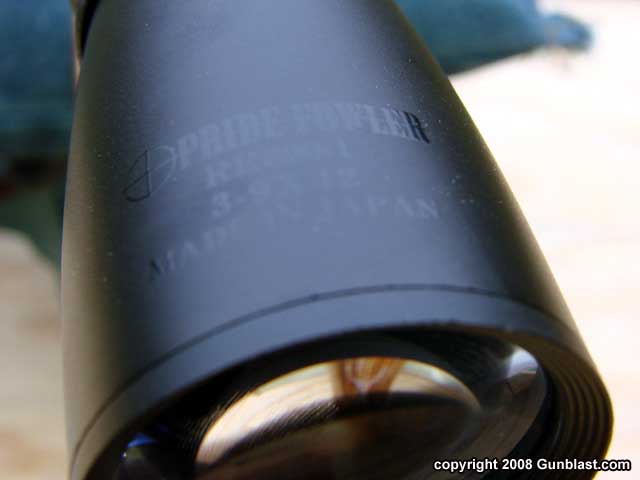
The Pride-Fowler scopes are
quality scopes assembled in Japan.
The quality is on par with our best made-in-America
scopes and approaches that of the high end European optics.
Perhaps the best compliment to Pride-Fowler is that Zeiss
has requested and been licensed to use the Rapid Reticle in some
of their scopes. For
the money though, the Pride-Fowler Rapid Reticle series scopes
are hard to beat.
Check out the Pride-Fowler scopes
at: www.rapidreticle.com.
Doug Mann
UPDATE!
July 9th, 2008
I recently had the opportunity to
really exercise the Pride-Fowler Model RR800-1 scope which I had
previously reviewed. I
was fortunate enough to be invited to attend the Shootists’
Holiday at the NRA
Whittington Center in Raton, New Mexico.
Knowing that the Whittington Center has ranges out to
1000 yards and beyond, I took along my Remington Model
700 which was still wearing the Pride-Fowler scope.
I had also recently traded into the better part of a
couple hundred rounds of Lake City M118 Match ammo.
This round is loaded with a 173 grain FMJ Boattail and
is/was the standard for 7.62 NATO long range work.
This load has since been replaced by the Federal Gold
Medal Match loading using the Sierra 175 grain Match
King.
To recap, the Pride-Fowler scopes
are made in Japan from premium materials (think Nikon).
Quality is on par with many of the pricier European and
American optics. The
Model RR800-1 is a 3 to 9 power variable scope with a 30mm main
tube and a nominal 42mm objective.
While it is far from dainty, it doesn’t look or feel
like so much cast iron sewer pipe atop your rifle.
It is fairly sleek.
The crowd pleaser in this scope, though, is the Rapid
Reticle designed by Mickey Fowler and John Pride.
Essentially, it is a bullet drop compensating reticle
with predetermined holdover crosshairs at ranges from 100 to 800
yards. The reticle
is located in the first focal plane of the scope, which means as
you change the magnification, the size of the reticle changes. I
had been itching to see how well the subtensions of the reticle
matched real distances since I had only been able to shoot out
to 200 yards or so.
The first day I dragged the
rifle/scope ammo combo out of its case, we were on the Hunter
Silhouette range. The
farthest distance there was 100 yards or so, but on the
mountainside behind the range are numerous rocks of varying
sizes and shapes. One
in particular is known as "The Banana Rock" and has
been ranged at 580 yards. I
had not adjusted the scope to the M118 round so I bracketed the
banana rock between the 500 and 600 yard crosshairs.
My first shot hit the rock around the middle and to the
right consistent with the steady left-to-right wind that was
blowing. I decided
to put the rig up until we could get to some longer ranges.
A couple of days later, we began
the morning at the Long Range Silhouette range. This range features numerous banks of silhouettes at known
distances… in meters. I
decided to check my zero on the 500 meter standing ram.
I held the 500 yard crosshair on the ram and shot just
under it. Bracketing
the ram between the 5 and 600 yard crosshairs resulted in center
mass hits. Remember,
the silhouette ranges are in meters – the rams were about 557
yards from the firing line, so this hold was consistent with the
range subtensions on the reticle.
Firing at rocks behind the rams using the 600 yard
crosshair produced hits with boring regularity.
I was ready to stretch out.
Chad at PFI had emailed me a PDF chart of windage
and elevation holds (and come-ups) for the Rapid Reticle, prior
to my departure for New Mexico.
The reticle’s longest range, or lowest crosshair, is
for 800 yards. To shoot at 1000 or more yards requires holding over or
dialing in enough MOA’s of elevation to put a crosshair on
target. At the
range, on the side of the mountain, is a silhouette of an
American Bison, a/k/a, a buffalo.
The buffalo is 1000 meters or 1123 yards from the firing
line. I was about
to start turning elevation clicks when I took a long look at the
reticle. Beneath
the 800 yard crosshair is a short length of thin vertical
crosshair that runs into the thicker vertical post at the bottom
of the sight picture. Comparing
the number of MOA’s needed to come up versus the length of
that skinny vertical hair at the bottom, it occurred to me that
the juncture of the thin and thick crosshairs at the bottom of
the sight picture might just be the proper hold for a 1000 yard
shot. So, I held
that aiming point at center mass on the buff silhouette and
launched a shot way downrange.
The dirt under the buff’s belly told me I was low, and
why not? That buff
is at 1123 yards, not 1000.
I reset myself behind the rifle and held the thin/thick
aiming point on the top of the buff’s shoulder where the
“hump” is at its peak.
It takes a few seconds for the
thwack of a bullet on steel to make its way back to the firing
line at that distance. Of
course I saw some white paint dust, but the sound reinforces
that it wasn’t a fluke. I
repeated the shot a few more times just to make sure.
The holdover was perfect.
The more time I spend with the
Pride-Fowler Model RR800-1, the less I want to send it back.
I may end up sending a check instead of the scope back to
Chad. This is an
excellent piece of equipment whose practicality must be
experienced to be appreciated.
If you are in the market for a high quality optic that
will enable accurate shooting from 100 to 1000 yards, and all
points in between, look at the Pride-Fowler line.
Doug Mann
Got something to say about this article? Want to agree (or
disagree) with it? Click the following link to go to the GUNBlast Feedback Page.
|
|
Click pictures for a larger version.
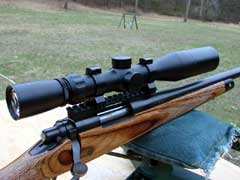
Pride-Fowler's RR800-1 3-9x scope with "Rapid
Reticle".
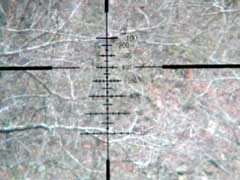
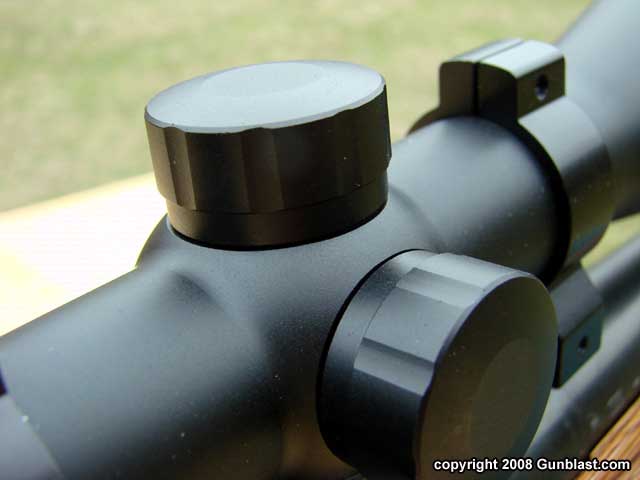
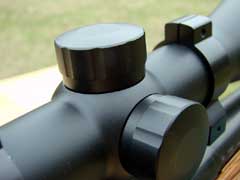
The heart of the Rapid Reticle system.
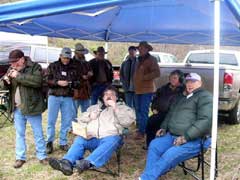
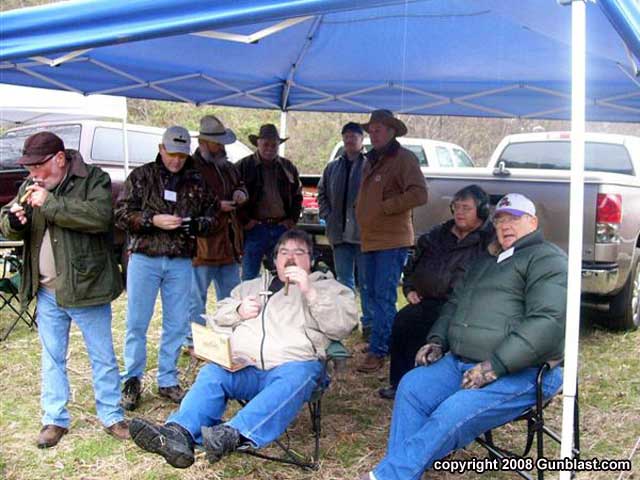
A
gathering of friends waits out the rain on the range at
the CSA 2008 shoot in Arkansas. Standing left-right: Ron
Brown, Doug Mann, Jeff Quinn, Jimmy Pilcher, Al
Anderson, and Chuck Smith. Seated left-right:
Boge Quinn (looking like a "celebrity"
puffing on his stogie), Mark Roberts, and Charlie
Smith.
|