There has been much interest in
recent years regarding big bore revolvers. Up until the last
few years, big bore meant .41 Magnum and larger. Lately, however,
the big bore sixguns of years past are seeming smaller in comparison
to today's new crop of bigger and more powerful cartridges.
Gun makers such as Freedom Arms,
along with custom gun builders like John Linebaugh and Hamilton
Bowen, have been producing some five-shot revolvers delivering more
power than ever believed possible a few years back.
Dick Casull started the ball rolling
with his awesome .454 Casull many years ago, using loads developed
with a combination of different powders, to achieve velocities with
.45 caliber bullets never seen from a revolver.
The firm of Sturm, Ruger, &
Company, has for many years been making strong, affordable sixguns
in both single and double action designs. Ruger is credited with
bringing back the single action revolver from the brink of extinction,
and continues to produce some of the finest single action revolvers
available, at a price that is under that of the Italian imports.
Ruger's double action revolvers
are built like the proverbial tank, using state-of-the-art production
techniques and materials. From their very first double action design,
the Security Six, Ruger dispensed with the traditional sideplate,
going for a much stronger solid-frame design. This same basic frame
design is still used in their double action revolvers, along with
improved lockwork, to build some of the strongest sixguns available.
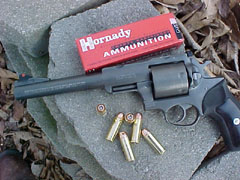
The largest of Ruger's revolvers is the Super Redhawk, and this
is the gun chosen to introduce the first cartridge to bear the company's
name - the .480 Ruger.
As most shooters are familiar with
the Super Redhawk, I won't go into detail here on the finer points
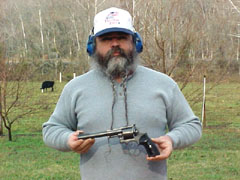
of the sixgun, and just give a general description. The revolver
that I received for testing wears a seven and one-half inch barrel,
but the Super Redhawk is also available with a two inch longer tube.
The sixgun has an ingenious cylinder lockup that is strong and durable,
giving extremely solid lockup front and rear, while maintaining
a simple, one-button latch. The Super is a large sixgun. You won't
be carrying this gun in your hip pocket, but with a good holster,
it rides pretty comfortably on the hip or across the chest. The
weight of the Super Redhawk with the 7 1/2" tube is 53 ounces, only
five more than the single action Super Blackhawk.
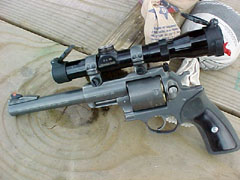
For handgun hunters who wish to
mount a scope sight on their revolver, this Ruger comes with built-in
scope mounts and matching rings, which are quickly detachable by
two large knurled nuts, in the event that access to the open sights
is needed. Most hunting sixguns require that the rear sight be removed
to mount a scope, but the Super Redhawk's mount is made into the
frame and in no way alters the adjustable sights. Personally, I
prefer not to use a scope sight while hunting with a handgun, but
for testing this gun I mounted a Charles Daly two power handgun
scope. For hunters who want a scope on their sixgun, while still
retaining the ability to access the open sights, this system is
the best that I have ever seen. It is both simple and strong. The
stainless steel construction of the Super Redhawk is finished in
a dull but smooth finish that Ruger calls Target Gray. It is both
non-reflective and attractive, giving the impression of a serious
hunting gun with a durable finish. The action of the Super Redhawk
was smooth, and in both single and double action, surprisingly light
for a revolver produced these days. The single action pull was very
crisp and broke at about 3.75 pounds.
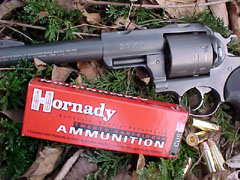
As for the .480 Ruger cartridge, Hornady is producing the ammunition with a 325 grain XTP/
Mag jacketed hollow point, with other bullets to be added
later. I would like to see this cartridge loaded with a stout cast
bullet of about 400 grains.
The muzzle velocity listed by Hornady
is 1350 feet per second with the 325 XTP/Mag bullet, and my
testing over my Pact chronograph bears this to be accurate. The
.480 achieved an average of 1332 fps twelve feet from the muzzle
of the 7 1/2" Ruger. The ammunition also proved to be very consistent,
with a mean average deviation of only 8.2, which must have contributed
to the excellent accuracy achieved with this sixgun.
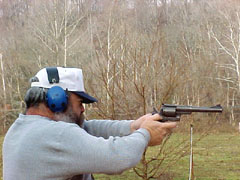
I fired the .480 at a steel swinging
plate target to get the feel of it, and while there was no
doubt that I was firing a powerful sixgun, the recoil was not at
all painful, thanks to the great cushioned rubber grips that are
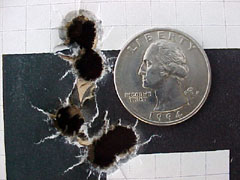
standard equipment on the Super Redhawk. Accuracy testing proved
to be a pleasant surprise, with five shots going into a 1.25 inch
group at 25 yards. The vertical dispersion of the group was due
to my inconsistency of hold during firing, as I was searching for
the best way to hold the gun over the bags, when I should have held
it the same for each shot. I was very surprised to find
such an accurate group under such conditions. Any handgun that will
shoot this good is worthy of being called accurate, but especially
a big bore revolver using factory ammunition. The Hornady
ammo was also very clean burning, leaving almost no trace of residue
in the bore or chambers of the gun.
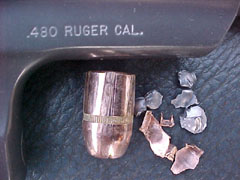
In an effort to check the XTP/Mag
bullet for expansion, I fired bullets into a bag of cottonseed meal
and also into water. The cottonseed meal has the consistency of
heavy sawdust, and the bullets fired into it showed no expansion
at all, behaving as a solid. The bullet fired into water went entirely
to pieces, the largest of which are pictured here. What is proved
by these tests as related to performance on real flesh, is nothing.
It was merely an attempt by me to capture a fired bullet. I will,
at a later date, try to test these bullets on live game. The reports
of others that I have received have been positive regarding the
performance of this bullet.
I have heard the question entertained
as to why Ruger chose to invent the .480 instead of bringing out
the .475 Linebaugh. Not being one that Ruger calls for advice on
these matters, I can only speculate. I do see an advantage to the
.480 as a cartridge capable of being chambered in Ruger's fine lever-action
and autoloading rifles. I would also love to have a .480 in a Ruger
Bisley with a 5-1/2 inch barrel. By going with the .480, which has
a smaller diameter case rim, Ruger was able to get six chambers
in their Super Redhawk, instead of only five.
In developing and offering this
sixgun to the shooting public, Ruger has produced a true big bore
revolver that is strong, reliable, and within the means of most
shooters. It isn't the biggest or most powerful round available,
nor was it meant to be. The .480 gives considerably more power than
most commonly used revolver cartridges, without the expense and
recoil of some of the custom and semi-custom sixgun rounds available.
It also is a cartridge that is just at the beginning of its development.
I am anxious to try some of the excellent Cast Performance gas check
hard-cast bullets in this cartridge. Kelly is sending me some of
them for testing, but they didn't arrive in time for this article.
I will do a report later on reloading the .480, as I develop more
data and gain experience with the sixgun.
If you would like more information
on this newest big bore sixgun or any of Ruger's products, check
out their website at: www.ruger-firearms.com
You can view the entire line of Hornady products at: www.hornady.com
If, like me, you would like to
see the .480 in the excellent Ruger Bisley, give Ruger a call at
520-778-6555 and tell them what you want. They don't know unless
you tell them. As usual, Ruger has again produced a fine handgun
for the hunters of this world, that should also prove popular with
metallic silhouette shooters.
If you need a sixgun with more power
than the average magnum, and that has target-grade accuracy to boot,
check out the Ruger .480 Super Redhawk.
Jeff Quinn

Got something to say about this article? Want
to agree (or disagree) with it? Click the following link to go to
the GUNBlast Feedback Page.